<!-- WP QUADS Content Ad Plugin v. 2.0.92 -->
<div class="quads-location quads-ad15875 " id="quads-ad15875" style="float:none;text-align:center;padding:0px 0 0px 0;" data-lazydelay="0">
<amp-ad 
 width="100vw" 
 height="320" 
 type="adsense" 
 data-ad-client="ca-pub-4964358903113472" 
 data-ad-slot="7296948979" 
 data-auto-format="rspv" 
 data-full-width 
 > 
 <div overflow></div> 
 </amp-ad>
</div>
<div class="aw-content whitespace-pre-wrap h-fit md:ml-2 lg:ml-0">In the world of material science and optics, Potassium Chloride, often referred to as KCl, plays a crucial role. Specifically, it is utilized as a window material in various applications. But, <strong>what is a KCl window?</strong> Let&#8217;s unravel this mystery together.</p>
<h2>Overview of Potassium Chloride (KCl)</h2>
<p>Potassium Chloride (KCl) is a crystalline compound that serves multiple purposes in various industries. It&#8217;s wide transmission band makes it suitable for optical applications spanning UV, visible, mid-wave, and far-IR regions. The comprehensive data sheet offers a detailed view into its properties.</p>
<h2>Key Properties of KCl</h2>
<p>The optical and physical properties of KCl make it a viable option for several applications. Here are some key properties:</p>
<!-- WP QUADS Content Ad Plugin v. 2.0.92 -->
<div class="quads-location quads-ad14936 " id="quads-ad14936" style="float:none;text-align:center;padding:0px 0 0px 0;" data-lazydelay="0">
<amp-ad 
 width="100vw" 
 height="320" 
 type="adsense" 
 data-ad-client="pub-4964358903113472" 
 data-ad-slot="3932419033" 
 data-auto-format="rspv" 
 data-full-width 
 > 
 <div overflow></div> 
 </amp-ad>
</div>

<ul>
<li><span class="flex items-start justify-start"><strong>Transmission range:</strong> 0.21 to 20µm</span></li>
<li><span class="flex items-start justify-start"><strong>Refractive Index:</strong> 1.45644 @ 10µm</span></li>
<li><span class="flex items-start justify-start"><strong>Density:</strong> 1.99 g/cm3</span></li>
<li><span class="flex items-start justify-start"><strong>Melting Point:</strong> 776°C</span></li>
<li><span class="flex items-start justify-start"><strong>Hardness:</strong> Knoop 7.2 <;110>;, 9.3 <;100>; with 200g indenter</span></li>
</ul>
<h2>Application of KCl in Optical Components</h2>
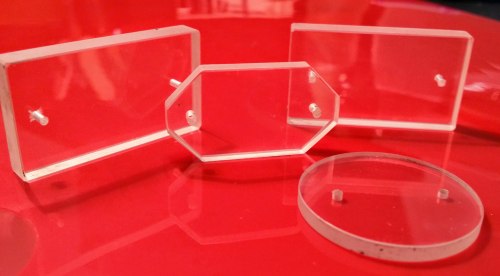
<p>KCl is used in a variety of optical components, including windows and ground blanks. Knight Optical, a prominent optical component manufacturer, supplies KCl windows with typical specifications like:</p>
<ul>
<li><span class="flex items-start justify-start"><strong>Diameter:</strong> <; 5mm to 80mm</span></li>
<li><span class="flex items-start justify-start"><strong>Form error (@633nm):</strong> <; 0.25 waves</span></li>
<li><span class="flex items-start justify-start"><strong>Centration/parallelism:</strong> <; 1 arc minute</span></li>
<li><span class="flex items-start justify-start"><strong>Scratch/dig:</strong> <; 40/20</span></li>
<li><span class="flex items-start justify-start"><strong>Typical coatings:</strong> BBAR @ 1-20µm, DLC @ 1-20µm</span></li>
</ul>
<h2>KCl Window for FTIR Applications</h2>
<p>KCl windows have a significant presence in FTIR applications due to their low solubility and reflection losses. Companies like Buck Scientific have been supplying high-quality FTIR windows made of KCl since 1970.</p>
<h2>Key Features of KCl Window</h2>
<ul>
<li><span class="flex items-start justify-start">KCl windows are less soluble than NaCl, with lower reflection losses</span></li>
<li><span class="flex items-start justify-start">They have an extended transmission range</span></li>
<li><span class="flex items-start justify-start">KCl is hygroscopic, meaning it absorbs moisture from the atmosphere</span></li>
<li><span class="flex items-start justify-start">The working wavelength range for KCl is 55,600 &#8211; 439 cm-1</span></li>
</ul>
<h2>KCl Window for CO2 Lasers</h2>
<p>KCl windows are particularly useful for sputter barrier windows in CO2 lasers due to their low refractive index and high threshold damage. They are known for their high infrared transmittance, with a transmittance greater than 90% when thickness is less than 10mm and in the range of 4000-500cm-1.</p>
<!-- WP QUADS Content Ad Plugin v. 2.0.92 -->
<div class="quads-location quads-ad14936 " id="quads-ad14936" style="float:none;text-align:center;padding:0px 0 0px 0;" data-lazydelay="0">
<amp-ad 
 width="100vw" 
 height="320" 
 type="adsense" 
 data-ad-client="pub-4964358903113472" 
 data-ad-slot="3932419033" 
 data-auto-format="rspv" 
 data-full-width 
 > 
 <div overflow></div> 
 </amp-ad>
</div>

<h2>Detailed Specifications of KCl Window</h2>
<ul>
<li><span class="flex items-start justify-start"><strong>Orientation:</strong> <;100>;, <;110>;, <;111>;</span></li>
<li><span class="flex items-start justify-start"><strong>Orientation Tolerance:</strong> <; 0.5°</span></li>
<li><span class="flex items-start justify-start"><strong>Parallelism:</strong> 5ã</span></li>
<li><span class="flex items-start justify-start"><strong>Perpendicularity:</strong> 3Ë</span></li>
<li><span class="flex items-start justify-start"><strong>Surface Quality:</strong> 10-5 (Scratch/Dig)</span></li>
<li><span class="flex items-start justify-start"><strong>Wavefront Distortion:</strong> <;λ/4@632 nm</span></li>
<li><span class="flex items-start justify-start"><strong>Surface Flatness:</strong> <;λ/8 @632 nm</span></li>
<li><span class="flex items-start justify-start"><strong>Clear Aperture:</strong> >;90%</span></li>
<li><span class="flex items-start justify-start"><strong>Chamfer:</strong> <;0.1×45°</span></li>
<li><span class="flex items-start justify-start"><strong>Thickness/Diameter Tolerance:</strong> ±0.05 mm</span></li>
<li><span class="flex items-start justify-start"><strong>Crystal Structure:</strong> Cubic</span></li>
<li><span class="flex items-start justify-start"><strong>Symmetry Class:</strong> m3m</span></li>
<li><span class="flex items-start justify-start"><strong>Lattice Constants:</strong> 6.291 Å</span></li>
<li><span class="flex items-start justify-start"><strong>Density:</strong> 1.989 g/cm3</span></li>
<li><span class="flex items-start justify-start"><strong>Melting Point:</strong> 776°C</span></li>
<li><span class="flex items-start justify-start"><strong>Cleavability:</strong> (100), perfect</span></li>
<li><span class="flex items-start justify-start"><strong>Thermal Conductivity:</strong> /(W·m-1·K-1)@46°C6.53</span></li>
<li><span class="flex items-start justify-start"><strong>Specific Heat:</strong> (J·kg-1·K-1)690</span></li>
<li><span class="flex items-start justify-start"><strong>Thermal Expansion:</strong> (10-6·K-1@60°C)34.1 … 38.3</span></li>
<li><span class="flex items-start justify-start"><strong>Hardness (Knoop):</strong> 7.2@<;110>;, 9.3@<;100>;</span></li>
<li><span class="flex items-start justify-start"><strong>Vickers Microhardness (GPa):</strong> 0.15</span></li>
<li><span class="flex items-start justify-start"><strong>Young’s Modulus (GPa):</strong> 16.8@<;110>;, 38.2@<;100>;</span></li>
<li><span class="flex items-start justify-start"><strong>Shear Modulus (GPa):</strong> 6.3@<;110>;, 10.8@<;100>;</span></li>
<li><span class="flex items-start justify-start"><strong>Bulk Modulus (GPa):</strong> 17.36</span></li>
<li><span class="flex items-start justify-start"><strong>Rupture Modulus (GPa):</strong> 4.41×10⁻³</span></li>
<li><span class="flex items-start justify-start"><strong>Elastic Coefficient (GPa):</strong> C11=40.2, C12=6.7, C44=6.29</span></li>
<li><span class="flex items-start justify-start"><strong>Transmission Range:</strong> 0.21 … 30µm</span></li>
<li><span class="flex items-start justify-start"><strong>Refractive Index:</strong> 1.488@0.6µm, 1.454@10.6µm</span></li>
<li><span class="flex items-start justify-start"><strong>Reflective Loss:</strong> 6.8%@10.0µm</span></li>
<li><span class="flex items-start justify-start"><strong>Reststrahlen:</strong> 63.1µm</span></li>
<li><span class="flex items-start justify-start"><strong>Poisson Ratio:</strong> 0.134 λ(μm)nλ(μm)nλ(μm)n0.21.71751.4703111.45270.51.496861.4683121.446311.479671.465912.51.44621.475181.4632151.432531.473591.4601201.394741.472101.4566301.2626</span></li>
</ul>
<p>So, to answer the question of <strong>what is a KCl window</strong> &#8211; it is an optical window made from Potassium Chloride, highly prized for its excellent optical properties and applications in various industries. From CO2 lasers to FTIR spectrophotometers, KCl windows play a pivotal role in modern technology.</p>
</div>
</p>

What is KCl Window: An In-Depth Look